 英语
英语 西班牙语
西班牙语 德语
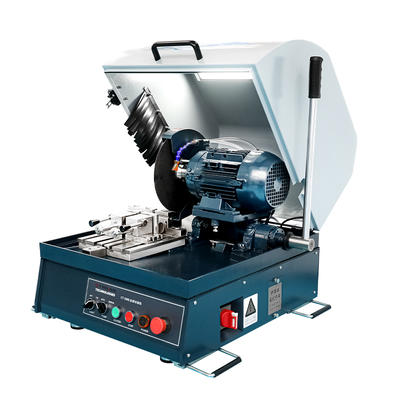
德语CT-250S/CT-250V Manual Sectioning Machine
CT-250S/250V is a manual sectioning machine designed with safety and environmental principles in min...
We use first- and third-party cookies including other tracking technologies from third party publishers to give you the full functionality of our website, to customize your user experience, perform analytics and deliver personalized advertising on our websites, apps and newsletters across internet and via social media platforms. For that purpose, we collect information about user, browsing patterns and device.
By clicking "Accept All Cookies", you accept this, and agree that we share this information with third parties, such as our advertising partners. If you prefer, you can choose to continue with "Only Required Cookies". But keep in mind that blocking some types of cookies may impact how we can deliver tailored content that you might like.
For more information and to customize your options, click on "Cookie settings". If you want to learn more about cookies and why we use them, visit our Cookie Policy page at any time. Cookie Policy

When a ball mill lining board wears through after only six months, the material is usually too soft for the ore being processed. Replacing it with white cast iron can extend service life to several years. The catch is that white cast iron will crack if the mill receives heavy tramp material or repeated impact loads. This trade-off between wear resistance and toughness is exactly why laboratory evaluation of microstructure and hardness matters before a component goes into service.
White cast iron is an iron-carbon alloy in which all carbon exists as cementite (Fe3C) rather than graphite. The white, crystalline fracture surface that appears when a sample is broken gives the material its name. The white structure forms during solidification when the cooling rate is fast enough, or when the alloy contains carbide-stabilizing elements such as chromium, to prevent carbon from precipitating as graphite.
White cast iron can also appear unintentionally. The chilled surface of a gray iron casting is actually white cast iron, and foundries often use this effect deliberately to create a hard working layer on cast iron rolls. However, the material is most commonly produced as an intentional wear-resistant alloy for demanding industrial environments.
The base chemistry of unalloyed white cast iron is straightforward: carbon within 2.0-3.5%, silicon below 1.5%, manganese in the 0.3-0.8% range, and restricted phosphorus and sulfur. The microstructure is dominated by an interconnected network of cementite platelets, with the matrix between them being pearlite, martensite, or retained austenite depending on the cooling history.
| Type | Carbon (%) | Chromium (%) | Nickel (%) | Hardness (HB) |
|---|---|---|---|---|
| Unalloyed | 2.0-3.5 | - | - | 350-500 |
| Low-alloy | 2.5-3.5 | 1-3 | - | 400-600 |
| Ni-Hard | 2.8-3.5 | 1.5-3 | 3-7 | 500-650 |
| High-chromium | 2.5-3.6 | 12-28 | 0-1 | 450-700 |
High-chromium grades are the most common alloyed type in modern industry. Chromium promotes M7C3 carbides, which are harder and more abrasion-resistant than cementite. Nickel in Ni-Hard alloys improves hardenability, allowing the matrix to transform to martensite during heat treatment, which raises overall hardness and wear performance.
The performance of white cast iron depends on its carbide-rich microstructure. The data cards below summarize the practical property ranges you can expect.
The hardest grades reach 700 HB, comparable to hardened tool steels. This hardness, however, comes with extremely low fracture toughness. The brittle cementite phase offers no resistance to crack propagation, so white cast iron parts survive pure abrasion very well but fail quickly under repeated impacts.
Three-body abrasion, where hard particles slide between two surfaces, is the dominant wear mode. The carbides resist cutting and plowing while the matrix holds them in place. If the matrix wears back too quickly, carbides are exposed and can be pulled out, accelerating material loss.
White cast irons are grouped by alloy content into four practical categories, each with distinct applications.
Grade selection normally comes down to the severity of abrasion versus the likelihood of impact. High-chromium grades are preferred for highly abrasive, low-impact environments such as grinding mills. For moderate abrasion with occasional impact, Ni-Hard or low-alloy grades may be more practical because they are less prone to cracking.
Verifying the microstructure of white cast iron is essential for quality control, but it is one of the more demanding sample preparation tasks in metallography. High hardness and brittleness create three specific challenges: cracking during sectioning, edge loss during mounting, and carbide pull-out during grinding and polishing.
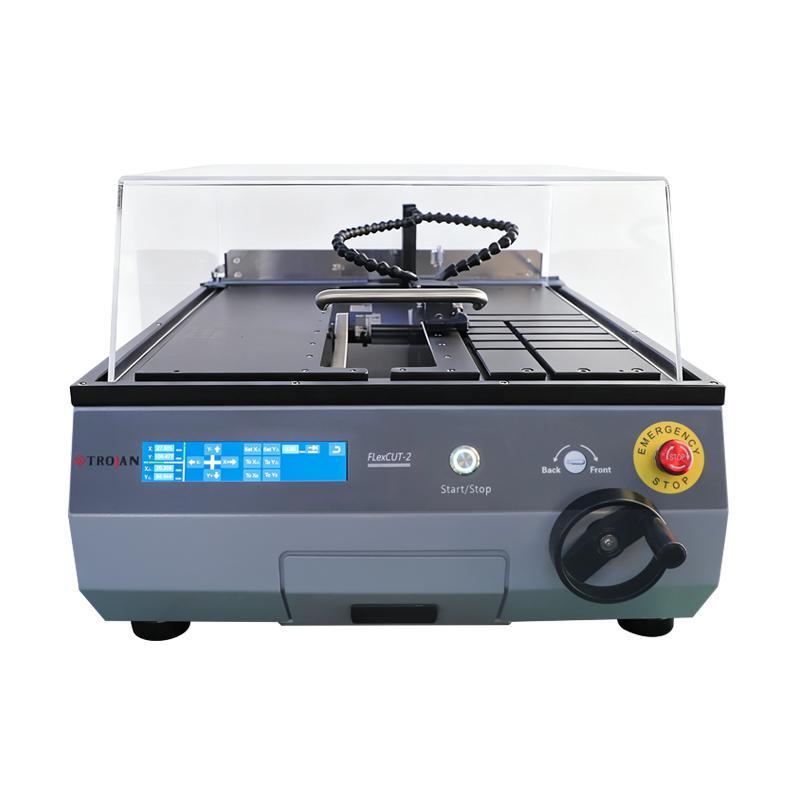
A precision cutoff machine with a slow, controllable feed rate is recommended to avoid wedging the blade and cracking the sample. High-pressure coolant must be used to keep the sample below the temperature that would cause microstructural change.
Beta250 automatic cutoff machine for metallographic sectioningEdge protection is critical because white cast iron edges chip easily. Use a mounting resin with edge-retention properties, such as a glass-filled epoxy, to preserve the sample edge through grinding and polishing.
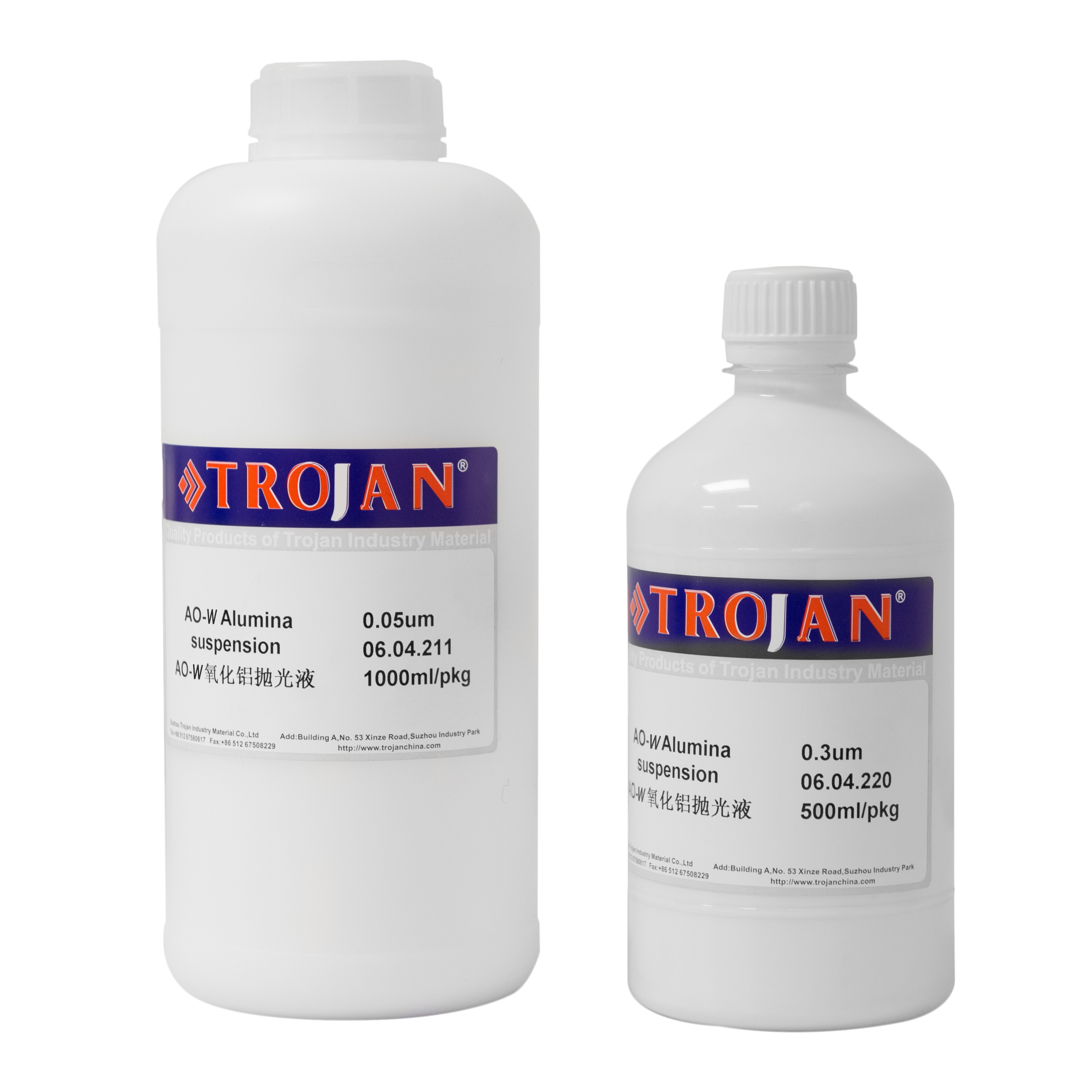
Start with 200-grit SiC paper and progress through 500, 800, and 1200 grit. For automated systems, use a programmable grinder-polisher to maintain constant pressure and speed. Diamond polishing stages at 6, 3, and 1 μm remove plastic deformation, and a final colloidal silica step produces a mirror-like surface.
Alpha610 automatic grinder and polisher for white cast ironNital (2-4%) reveals the pearlite and martensite matrix. For high-chromium grades, use Murakami's reagent or electrolytic etching to distinguish M7C3 carbides from the matrix. Once prepared, the microstructure can be assessed against standards such as ASTM A532 for abrasion-resistant cast irons.
Setup resources such as the cutting application guide and the metallographic sampling guide provide step-by-step support for establishing a reliable preparation procedure.
Hardness is the primary specification for white cast iron, and selecting the correct test method is important. Brinell testing with a 5 mm tungsten carbide ball at 500 kg load is the conventional method for unalloyed and Ni-Hard grades, because the large indentation averages out the heterogeneous carbide and matrix structure.
For high-chromium white cast iron, Vickers hardness testing is preferred. The diamond pyramid indenter measures local hardness, works well on high-hardness alloys, and allows evaluation of individual phases at the microstructural scale.
HVS-1000A Vickers hardness tester for white cast ironRockwell C testing is less common for white cast iron because the hard, brittle surface can crack around the indentation, particularly near sample edges. Be cautious when converting hardness between methods, since carbide-rich structures do not follow steel conversion charts reliably.
White cast iron sits at one end of the cast iron spectrum. The table below compares it with the other main cast iron types.
| Type | Carbon Form | Hardness (HB) | Machinability | Impact Resistance | Typical Use |
|---|---|---|---|---|---|
| Gray | Graphite flakes | 150-260 | Good | Low | Engine blocks, brake discs |
| White | Cementite | 350-700 | Grinding only | Low | Mill liners, pump parts |
| Ductile | Spheroidal graphite | 130-300 | Good | Excellent | Gears, crankshafts |
| Malleable | Temper carbon | 100-350 | Good | Good | Pipe fittings, brackets |
This comparison clarifies why white cast iron is never used for structural components. When the operating condition is abrasive wear, however, the other three types cannot compete on service life.
All of its carbon is present as cementite (Fe3C), a very hard intermetallic compound. With no soft graphite phase to weaken the matrix, white cast iron reaches hardness values comparable to hardened tool steels.
No. Conventional cutting tools cannot machine it. Only grinding is practical for finishing. Components are typically cast close to the final shape and ground when tight dimensions are required.
White cast iron has no graphite and all carbon is locked into carbide, creating a white fracture, extreme hardness, and brittleness. Gray cast iron contains graphite flakes, which produce a gray fracture, good machinability, and vibration damping.
Brinell with a 5 mm carbide ball at 500 kg is the conventional method for unalloyed and Ni-Hard grades. Vickers is preferred for high-chromium grades and for measuring individual carbide phases.
Use a precision cutoff machine with a controllable feed rate, a suitable abrasive blade, and high-pressure coolant. Avoid excessive feed pressure, which is the main cause of cracking and carbide fracture.

Based in China, TROJAN pays attention to the international market, and has sold metallographic equipment to more than 50 countries, such as Europe, America, Japan and South Korea, Southeast Asia countries and regions